
Gyesan Cathedral (Our Lady of Lourdes), Daegu Visitor Guide

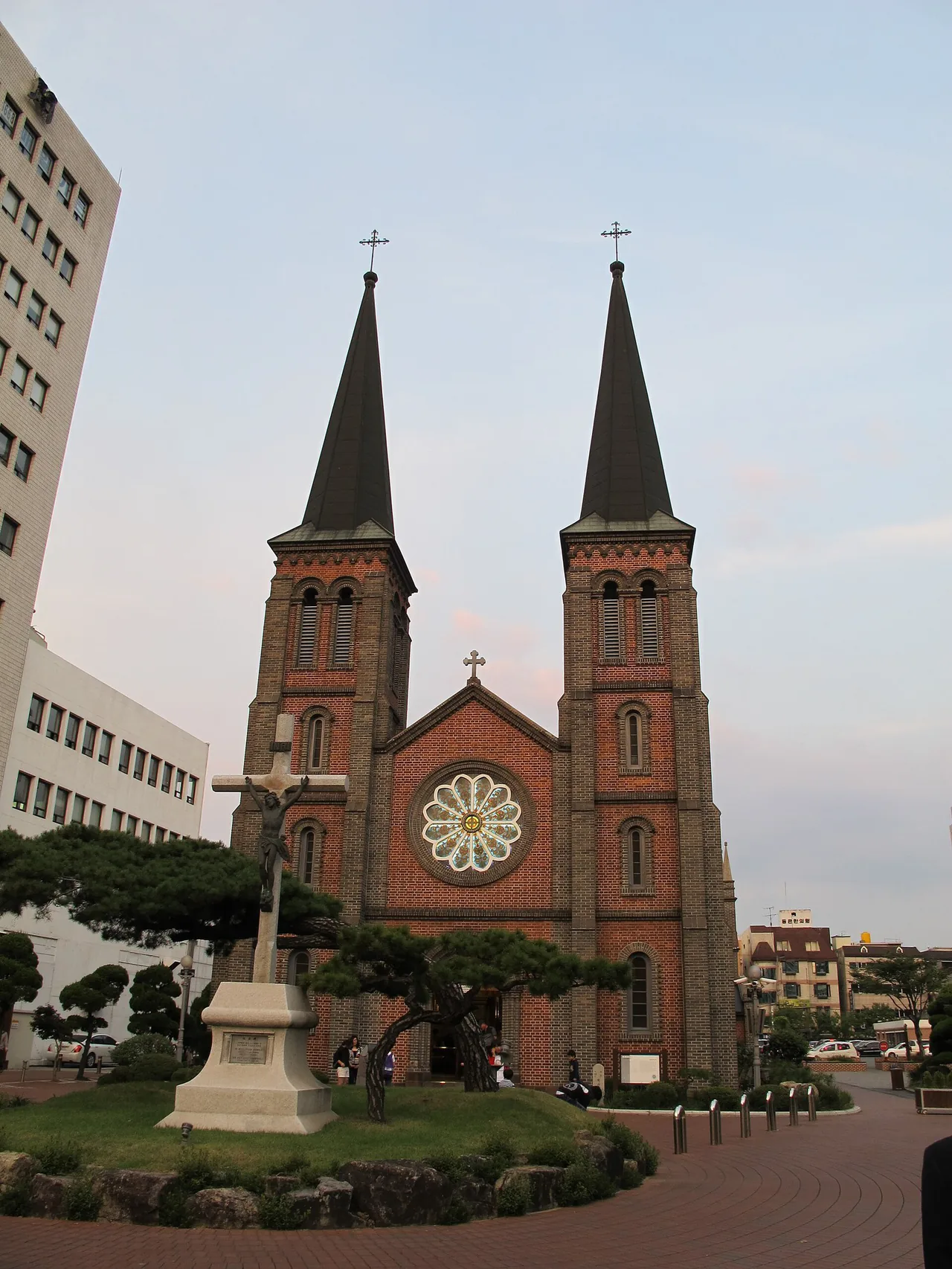
Last updated November 2026. This Gyesan Cathedral visitor guide covers Mass times, free entry, and the short walk from Banwoldang station. Daegu's tourism site calls this twin-spired brick church in Jung-gu the oldest church in the Gyeongsang region.
Gyesan Cathedral is a working parish as well as a landmark, so a smooth visit depends on timing around Mass. Below we cover hours, access, history, what to look for, and how to fold the church into a Modern Alley walk.
Gyesan Cathedral Hours, Mass Times and Entry
Admission is free, according to Visit Korea, the national tourism organization. Visit Korea publishes a Mass schedule for the cathedral rather than fixed visiting hours. Daegu Tour, the city's tourism site, lists visiting hours as no restriction.
The church interior's own opening times are not published, and this is an active parish, so avoid walking in during Mass. Plan your visit around the Mass times below, which come from Visit Korea.
On Monday only one Mass is listed, at 06:30. Sunday has eight listed Masses, from 06:30 to 21:30.
The parish website lists office hours of 09:00 to 20:00 Tuesday to Friday, 09:00 to 20:30 on Saturday, and 07:00 to 22:30 on Sunday. The parish office is closed on Mondays, so do not plan to ask questions there that day.
- Sunday Masses
- According to Visit Korea, the morning Sunday Masses start at 06:30, 08:30, 09:30, and 11:00.
- The afternoon and evening Sunday Masses run at 16:00, 17:30, 20:00, and 21:30.
- Monday Mass
- Visit Korea lists a single Monday Mass, held at 06:30 in the early morning.
- Tuesday to Friday Masses
- Weekday Masses from Tuesday through Friday are listed at 06:30, 11:30, and 19:30 by Visit Korea.
- Saturday Masses
- Visit Korea lists a regular Saturday Mass at 06:30, plus special Masses at 16:00 and 19:30.
How to Get to Gyesan Cathedral from Banwoldang
The easiest route is the Daegu Metro to Banwoldang station, which Lines 1 and 2 share. Take exit 18 and walk about 5 minutes, according to the parish's directions page. Daegu Tour describes the cathedral as standing at Gyesan Five-way Junction.
The address is 10 Seoseong-ro, Jung-gu, Daegu, with postal code 41933. Paste that into a Korean map app if the junction layout confuses you.
Visit Korea notes that parking is available for a fee, and Daegu Tour puts the rate at ₩1,800 per hour. Because the cathedral is a short walk from a metro station, the train is the simpler option.
Two metro lines meeting at Banwoldang also make the stop easy to add to a day that crosses central Daegu.

History of Our Lady of Lourdes Cathedral
The Daegu parish was founded in December 1885 under its first pastor, the French missionary Achille Paul Robert (Kim Bo-rok). He built a cross-shaped hanok church on this site in 1899, but it burned down soon after its dedication.
Sources disagree on the exact date of that fire, so we leave it at soon after the dedication. Robert then planned a fireproof brick church, and construction began in 1901.
Bricklayers and carpenters came from China, while the stained glass and fittings were ordered from France. The church was finished in May 1902 and consecrated on November 1, 1903.
It became the cathedral when the Daegu Vicariate was created in 1911, and it was enlarged between 1911 and 1918. A restoration followed in 1991 and 1992.
Pope John Paul II visited on May 5, 1984. The cathedral had already been designated Historic Site number 290 on September 25, 1981. For more regional history afterward, the Daegu National Museum makes a natural next stop.
What to See and How to Behave Inside
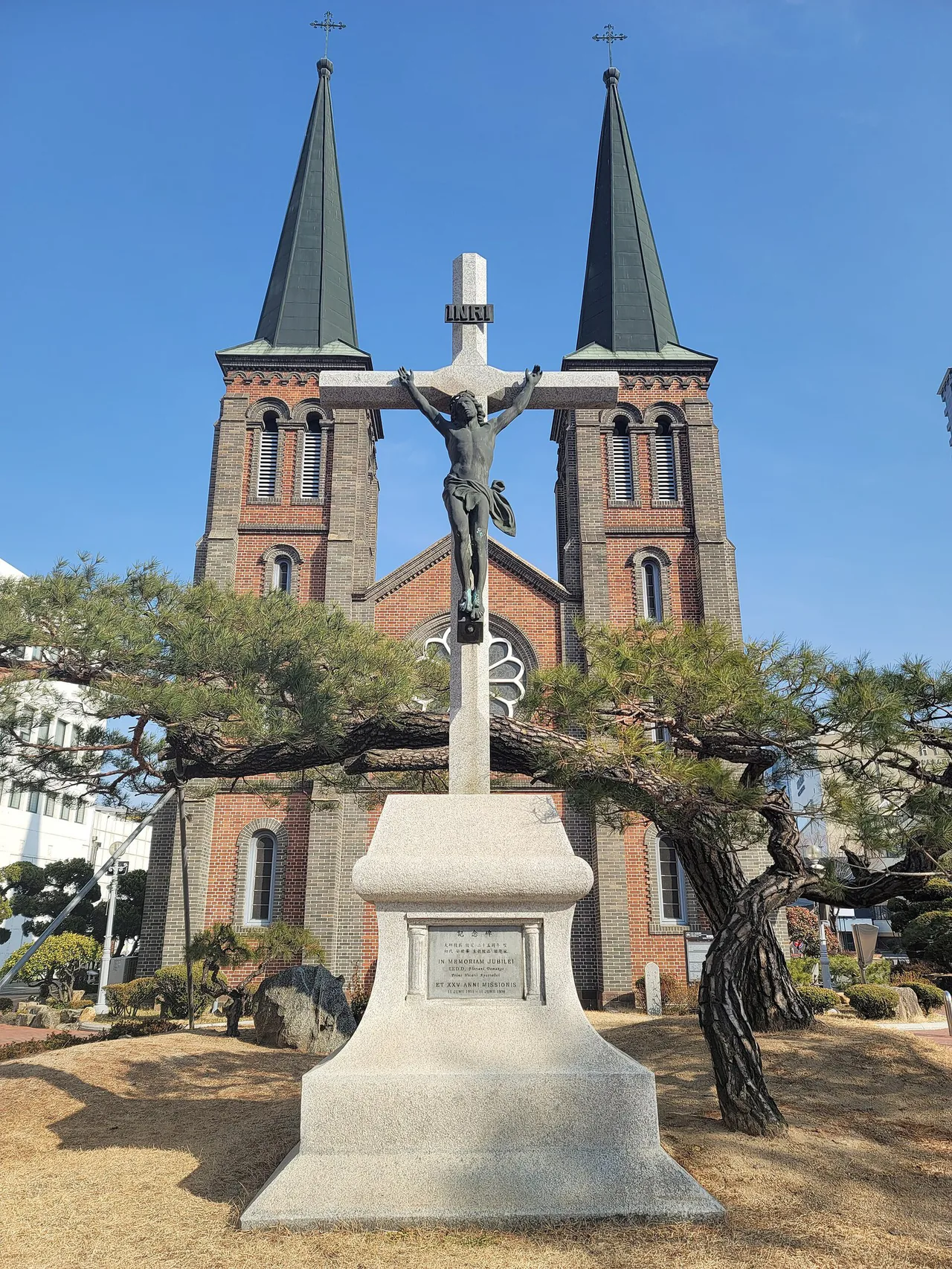
The Gothic exterior is built of red and grey brick on a granite base, with twin bell towers on the west front. Rose windows and the stained glass that Daegu Tour highlights reward a slow look from the garden.
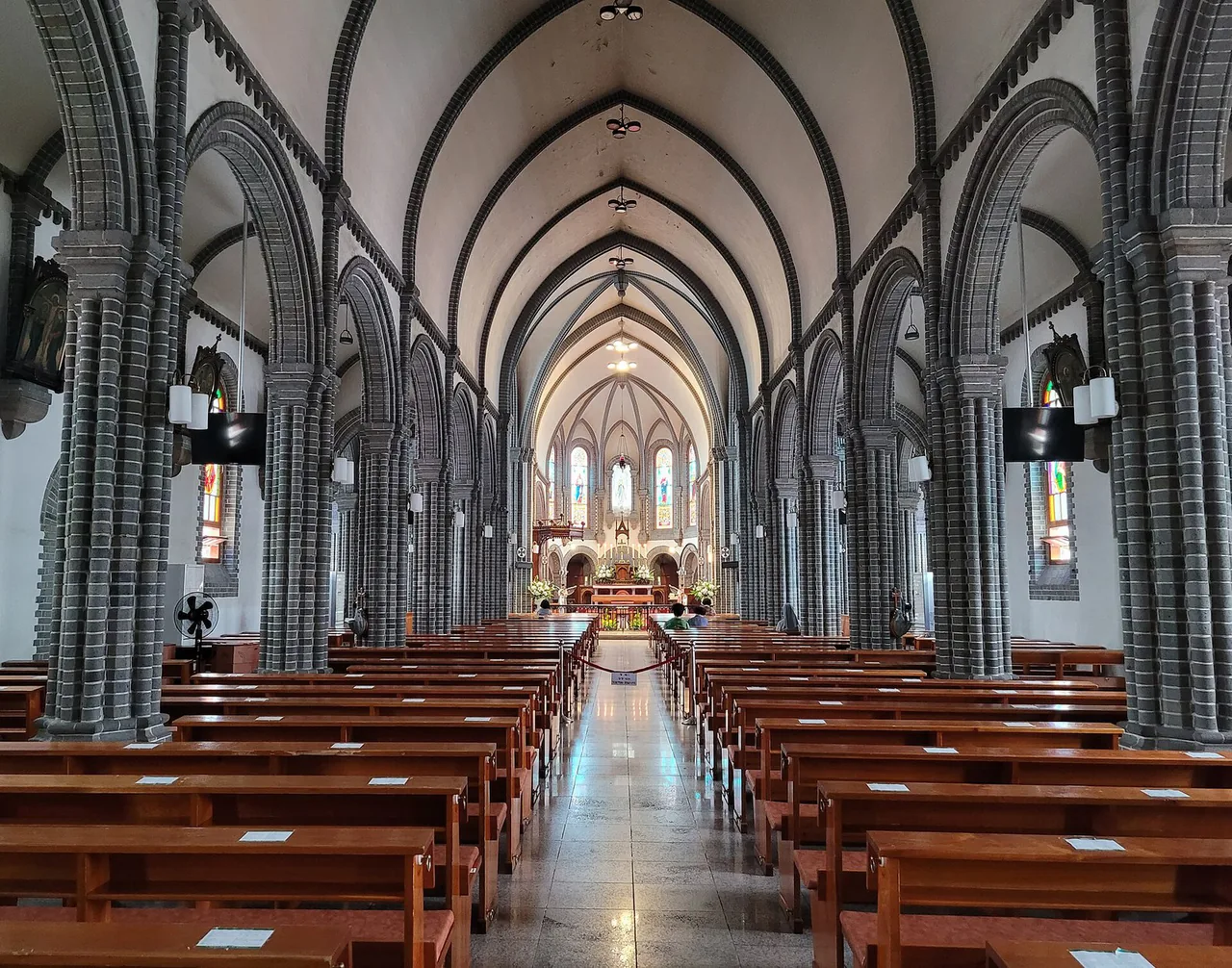
Inside, the plan is a Latin cross with three aisles, and grey-brick columns carry pointed arches toward the altar. The two bells in the towers were named Augustino and Gelmana after their donors.
The most common mistake is arriving just before a Mass and treating the nave like a museum. Time your visit between listed services, and walk the exterior first if a Mass is running.
On Tuesday to Friday there is no listed Mass between 06:30 and 11:30, which leaves a long gap for a visit. Saturday and Sunday both have a Mass at 16:00.
Keep your voice low, dress modestly, and ask before photographing during a service. Sunday has the most Masses, so a weekday visit leaves more open time between services.

Pairing the Cathedral With the Modern Alley Walk
Daegu Tour lists Jung-gu's Alley Tour Course 2, the Modern Culture Alley, as a 1.64 km walk of about 2 hours. The course starts at Cheongna Hill and passes Gyesan Cathedral.
Daegu Tour also lists free guided walks on Saturdays at 10:00 and 14:00. Saturday also has Masses at 16:00 and 19:30, so check the guided walk's timing against them if you plan to go inside.
Afterward, you can continue to Kim Kwang-seok Street for a different side of the city.
Frequently Asked Questions
How old is Gyesan Cathedral?
The present brick church was finished in May 1902 and consecrated on November 1, 1903. An earlier hanok church built on the site in 1899 burned down.
Can tourists visit Gyesan Cathedral?
Yes. Daegu's official tourism site lists the cathedral as an attraction with no set visiting hours; it is also an active parish with Mass every day.
What are the Mass times at Gyesan Cathedral?
Sunday 06:30, 08:30, 09:30, 11:00, 16:00, 17:30, 20:00 and 21:30; Saturday special Mass 16:00 and 19:30; Monday 06:30; Tuesday to Friday 06:30, 11:30 and 19:30; Saturday morning 06:30.
How do I get to Gyesan Cathedral?
Take the metro to Banwoldang station, use exit 18 and walk about 5 minutes. The address is 10 Seoseong-ro, Jung-gu.
Is Gyesan Cathedral a historic site?
Yes. It was designated Historic Site No. 290 on September 25, 1981, as the oldest Western-style church in the Gyeongsang region.
Did the Pope visit Gyesan Cathedral?
Pope John Paul II visited on May 5, 1984.
Is Gyesan Cathedral on the Daegu Modern Alley tour?
Yes. Jung-gu's Alley Tour Course 2 (Modern Culture Alley, 1.64 km, about 2 hours) starts at Cheongna Hill and passes the cathedral; free guided walks run on Saturdays at 10:00 and 14:00.
Gyesan Cathedral rewards a short, well-timed stop: free entry, an easy metro walk, and a brick Gothic facade that has stood since 1902. Keep the Mass schedule open on your phone and visit between services. For more ideas nearby, browse our full list of Daegu attractions and build the cathedral into a longer day.
For more Daegu planning, read our 10 Best Things to Do in Daegu: Routes, Costs & Tips (2026), Best Time to Visit Daegu: Month-by-Month Guide and Anjirang Gopchang Alley, Daegu: How to Eat There (Guide) guides.